Home › Services › Storm & Hail Damage
Fort Bend County's hail history is real, narrow and much smaller than the door-knocking suggests. Here is what the ground-truth spotter record actually shows, what hail physically does to a composition roof, and how to tell it apart from a roof that is simply old.
These are spotter reports — observations made by people on the ground, with a location, a date and a measured stone size:
Austin Parkway and Sweetwater Boulevard, Sugar Land. The largest recent local event and the one most likely to have marked sound shingle.
New Territory. The day before the Austin Parkway event, from the same active period.
Two separate Sugar Land reports on the same day.
Fort Bend County recorded no hail spotter reports at all across the entire year. Storm demand here can be a dead year, which is exactly why a roofing decision should not wait on one.
The season is narrow: 39 of the 57 all-time Fort Bend County hail reports fall in March and April. By June the risk has largely passed for the year.
Figures like "27 hail days in Sugar Land last year" come from radar-derived MRMS estimates rather than observations. Those estimates are generated from the KHGX radar roughly 56 km away, and the MESH algorithm systematically over-counts — it flags hail aloft that frequently never reaches the ground. Nothing on this page uses them. Where a number appears above, someone stood in it and measured it.
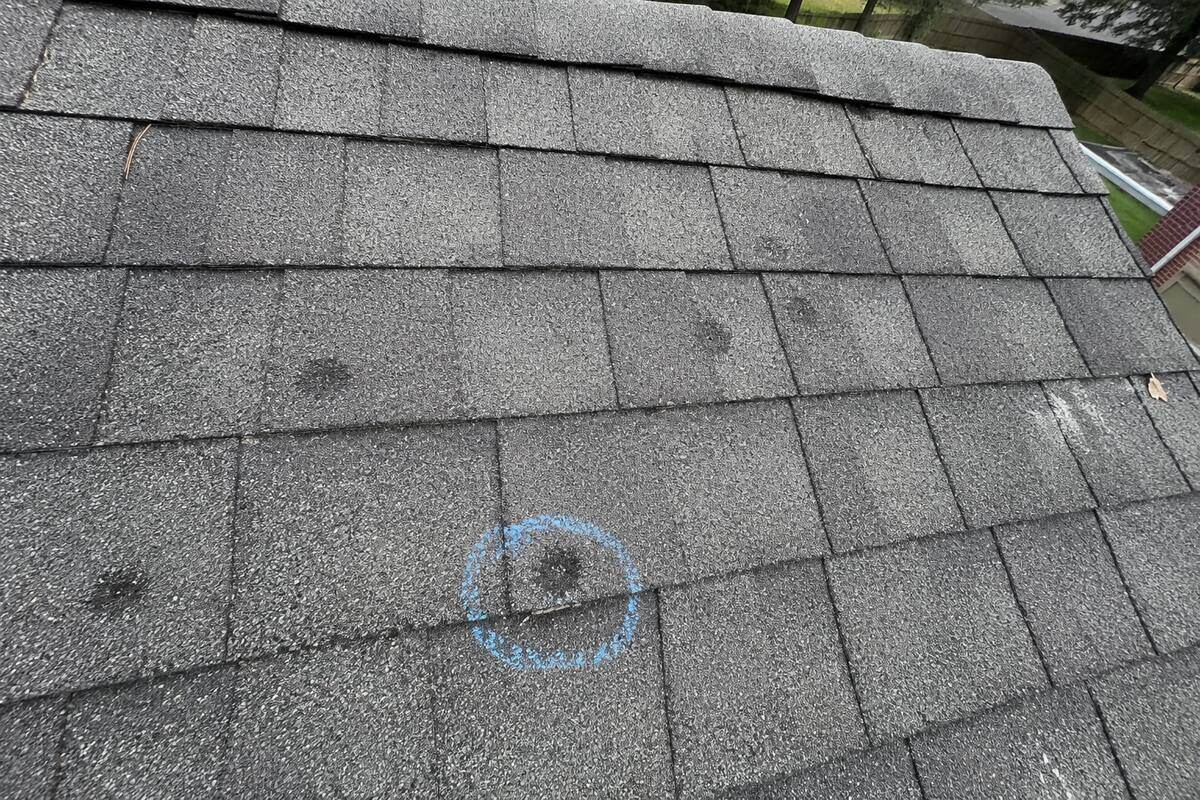
Hail damage on composition shingle is rarely a hole. It is a bruise: the stone fractures the asphalt mat beneath the granule surface and dislodges granules at the impact point. The shingle looks broadly intact and is soft to the touch at the mark, like a bruise on fruit. What actually happens next is that the exposed mat weathers far faster than the granule-protected surface around it, so a hail-bruised roof fails years earlier than it otherwise would — which is why the damage matters even when nothing is leaking.
Genuine hail marks are distributed randomly across a slope with no pattern. Anything in a line or a cluster is mechanical.
Wind-driven hail hits some slopes hard and leaves others untouched. A roof damaged on every elevation equally is unusual.
Gutters, downspouts, vent caps, flashing and the fins on the AC condenser dent visibly. They are the easiest confirmation that an event actually reached the ground at your address.
An old roof shedding granules evenly can read as hail damage to an untrained eye — or to a motivated one. See roof age assessment.
Most Fort Bend County storm damage is wind rather than hail: lifted tabs, missing ridge cap, torn flashing. That is ordinary roof repair territory.
Mature live oaks over older Sugar Land rooflines drop branches in serious wind. A strike can fracture decking under shingles that look fine.
This is worth stating plainly because a great deal of Texas roofing content assumes otherwise. The Texas Windstorm Insurance Association's designated catastrophe area covers fourteen first-tier coastal counties plus the part of Harris County east of Highway 146. Fort Bend County is not among them.
Practically, that means there is no WPI-8 windstorm certificate to obtain here, no mandatory TDI-approved assembly requirement, and no TWIA policy pathway. Wind coverage on a Sugar Land house comes through the ordinary homeowners policy, and the roof itself is governed by the City's adopted building code. If a contractor starts talking about windstorm certification on a Sugar Land address, they are working from a Galveston or Brazoria County playbook.
On design wind speed: Houston publishes an ultimate design wind speed of 139 mph for Risk Category II structures in Exposure B. Sugar Land's own adopted values were not retrievable at the time of writing, so treat 139 mph as Houston-area criteria rather than a Sugar Land figure. Getting the adopted value right for a permit is the contractor's job, not yours — call (281) 374-4829 and the contractor you are connected with will work to the value the City actually enforces for your address. The City's Permits & Inspections line is (281) 275-2270.
This site connects homeowners with independent local roofing contractors, and that is the whole of it. It does not file, negotiate, adjust or settle insurance claims, and it makes no representation about what any policy will or will not pay. Under Texas Insurance Code §4102.163, a contractor is barred from acting as a public adjuster on a property they are also doing contracting work on — so a roofer offering to take that off your hands is offering something they are not permitted to provide. Your policy is a conversation between you, your agent and your carrier.
What a roofing contractor can properly do is describe the physical condition of the roof: what is damaged, how, and what it costs to put right. That is the assessment. Everything after it is yours.
Hail bruising is round, randomly scattered across the slope, and soft to the touch where the mat has fractured under the granule surface. Ordinary wear is even, follows the sun exposure, and shows as uniform granule thinning rather than discrete marks. Mechanical marks from a ladder or foot traffic are linear and clustered. The most common misread on an older Sugar Land roof is calling age-related granule loss hail damage — which is one more reason to settle the roof's age first.
There is no single threshold, because impact energy depends on stone size, density, fall speed and the angle it strikes at, and an old brittle shingle fractures at a size that a new one shrugs off. As a rough guide, marble-size stones around 1.0 inch can mark an aged roof, and 1.5 inch and up is where damage to sound composition shingle becomes likely. The May 1, 2026 event at Austin Parkway and Sweetwater Boulevard was in that second band.
No, and it is worth knowing that no roofing contractor in Texas may lawfully do that for you either. Texas Insurance Code §4102.163 bars a contractor from acting as a public adjuster, or advertising to adjust claims, on any property they are also providing contracting services for. Anyone offering to negotiate or settle with your carrier as part of selling you a roof is describing something they are not permitted to do. Your policy is between you, your agent and your carrier.
Be careful with it. After any Fort Bend County hail event, out-of-area crews work the neighborhoods, and the free inspection is the opening of a sales call rather than a service. Prefer a contractor with a Fort Bend County address that existed before the storm, and settle the roof's age independently first — on a nineteen-year-old roof, the age matters more than the storm does.
Get connected with an independent Fort Bend County roofing contractor for a straight assessment of what the roof actually needs.
Call (281) 374-4829 Request an Estimate Sugar Land