Home › Services › Roof Leak Repair
A brown ring on a bedroom ceiling is the last event in the sequence, not the first. Finding a roof leak means working backwards up the slope from the stain to the penetration — and in Sugar Land, ruling out the two other things in the attic that make identical stains.
Field shingles in the open middle of a slope are the least likely place for a leak on a roof that is not at the end of its life. Water gets in where the roof plane is interrupted:
The rubber collar around each plumbing stack. Cracks from UV exposure long before the shingles wear out, and sits high on the slope so it feeds a long run of decking.
Where the roof meets something vertical. Step flashing that has been face-nailed or sealed rather than woven in is a chronic source.
Two slopes converging concentrate an enormous volume of water into a narrow channel. Debris packs there, water backs up under the shingle edge.
A skylight is a hole in the roof with a frame around it. See skylight and flashing repair.
Backed-out or overdriven fasteners. Individually tiny, collectively the reason some roofs leak in six places at once.
Gulf Coast squall lines drive rain horizontally. Water gets under the drip edge and behind fascia in ways ordinary rain never does.
This is genuinely local, and it is the reason a "roof leak" here needs an attic inspection before a roof estimate. Fort Bend County houses are slab-on-grade — no basement, no crawlspace — so two systems that live below the floor in other parts of the country live above the ceiling here.
The attic air handler runs for eight months a year in this climate and produces condensate the whole time. A blocked primary drain line, or a rusted-through emergency pan of the sort common in 1980s and 1990s First Colony attics, puts water on the ceiling board in exactly the pattern a roof leak does. The secondary drain line dripping over a front window is the design telling you this has already happened.
With no crawlspace, water lines to upstairs bathrooms run through the attic. They fail from age, from freeze events, and — documented across the Houston metro — from rodents chewing them. If the source turns out to be a pipe rather than the roof, that is the right first call; once ceilings and walls are saturated, the drying becomes its own job.
Where rodents are the cause, the entry point is usually on the roof — a displaced soffit vent screen, a gap at a roof return, a lifted section of fascia. That makes it a roofing problem with a plumbing symptom, which is exactly the kind of thing an attic inspection catches and a ceiling patch does not.
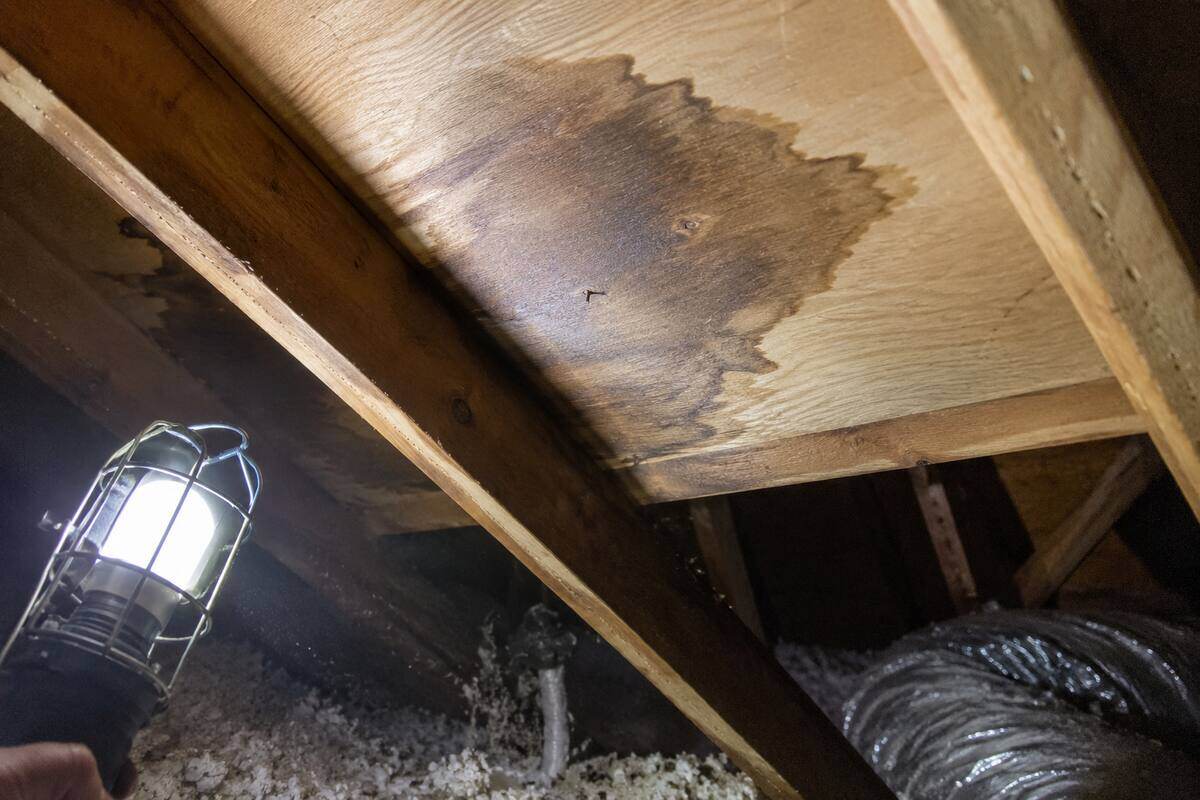
Dry staining on the underside of the decking and along rafters maps the water's route. The highest point of staining is nearest the entry.
The position in the attic corresponds to a specific area of roof. That is where the search starts — not with a general walk of the whole slope.
A hose run in controlled sections, working uphill, with someone watching in the attic. Slow and unglamorous, and the only method that actually proves the source.
A single failed penetration on a twelve-year-old roof is a repair. Three separate entry points on a nineteen-year-old roof is not — see roof replacement.
Stopping the water and repairing the damage it caused are two different scopes and often two different trades. Saturated blown insulation does not recover its R-value and generally comes out. Ceiling board that has been wet more than once is usually replaced rather than repainted, because the stain will bleed through fresh paint. Getting the roof sorted first is the right order — there is no point finishing a ceiling under a leak.
Almost never. Water entering at a penetration runs down the underside of the decking until it meets a rafter or a truss chord, then travels along that member until it finds a low point to drip from. A stain six or eight feet from the entry point is ordinary. This is why chasing a leak from inside the finished ceiling wastes money.
Sometimes, and it is the fastest way when it works — active water in the attic points straight at the path. The problem is that it is unsafe to be on a roof in Gulf Coast rain and hard to see anything from below. The usual method is an attic inspection on a dry day to read the staining, then a controlled water test on the suspect area.
Often, and in Sugar Land specifically. Houses here are slab-on-grade, so both the attic air handler and the supply lines to upstairs bathrooms run through the attic. A blocked primary condensate drain, a failed emergency pan, or a chewed supply line all produce a ceiling stain that looks exactly like a roof leak. Ruling those out first is standard practice, not an upsell.
In this humidity, not long. Decking that stays damp delaminates rather than drying out, blown insulation loses its R-value permanently once saturated, and mold growth in an attic that runs warm most of the year is a matter of weeks rather than months. The cost curve on a roof leak is steep, which is the argument for looking in the attic at the first sign rather than the third.
Get connected with an independent Sugar Land roofing contractor who will start in the attic rather than on the shingles.
Call (281) 374-4829 Request an Estimate Sugar Land