Home › Services › Skylight & Flashing Repair
A roof plane made of nothing but shingles rarely leaks until it is worn out. Everything that interrupts the plane — a chimney, a wall, a skylight curb, a plumbing vent — is a joint, and joints are what fail first.
The rubber collar around each stack. Shortest-lived component up there and the most frequent single cause of a mystery ceiling stain in this market.
Step flashing woven into the shingle courses up each side, counter-flashing let into the masonry above it, and a cricket on the uphill face of a wide chimney to split the water.
Where a roof plane dies into a two-story wall — extremely common on 1990s Sugar Land elevations. Kickout flashing at the bottom of that run is the detail most often missing, and its absence sends water inside the wall rather than into the gutter.
A framed opening in the roof with glass in it. The curb needs the same step, head and apron flashing treatment as a chimney, and it needs it on all four sides.
Roof-mounted exhaust terminations. The flange under the shingles is what seals them, not the hood on top.
Anything screwed through the roof. Mounts fitted after the roof went on are a common leak source, particularly where the installer relied on a sealant washer alone.
Where a sloped roof runs into a vertical wall and stops — a garage roof meeting the second-story wall above it, for instance — the water traveling down that intersection has to be thrown clear at the bottom into the gutter. The piece that does it is a small angled flashing at the lower end of the step-flashing run, called a kickout or diverter.
When it is absent, and on a great many houses built through the 1980s and 1990s it is, the water instead runs behind the gutter and down inside the wall cladding. The visible symptom shows up years later as staining or rot at the base of that wall, or as a damp interior corner nowhere near the roof. Homeowners investigating that usually start with the siding. It is a roofing detail, it is cheap to add, and it is worth asking about specifically on any Sugar Land house with a roof-to-wall junction.
A vent boot is a genuine repair: the old one comes off, shingles are lifted, a new boot goes in under the courses above and over the courses below. It is an hour's work and it stays fixed.
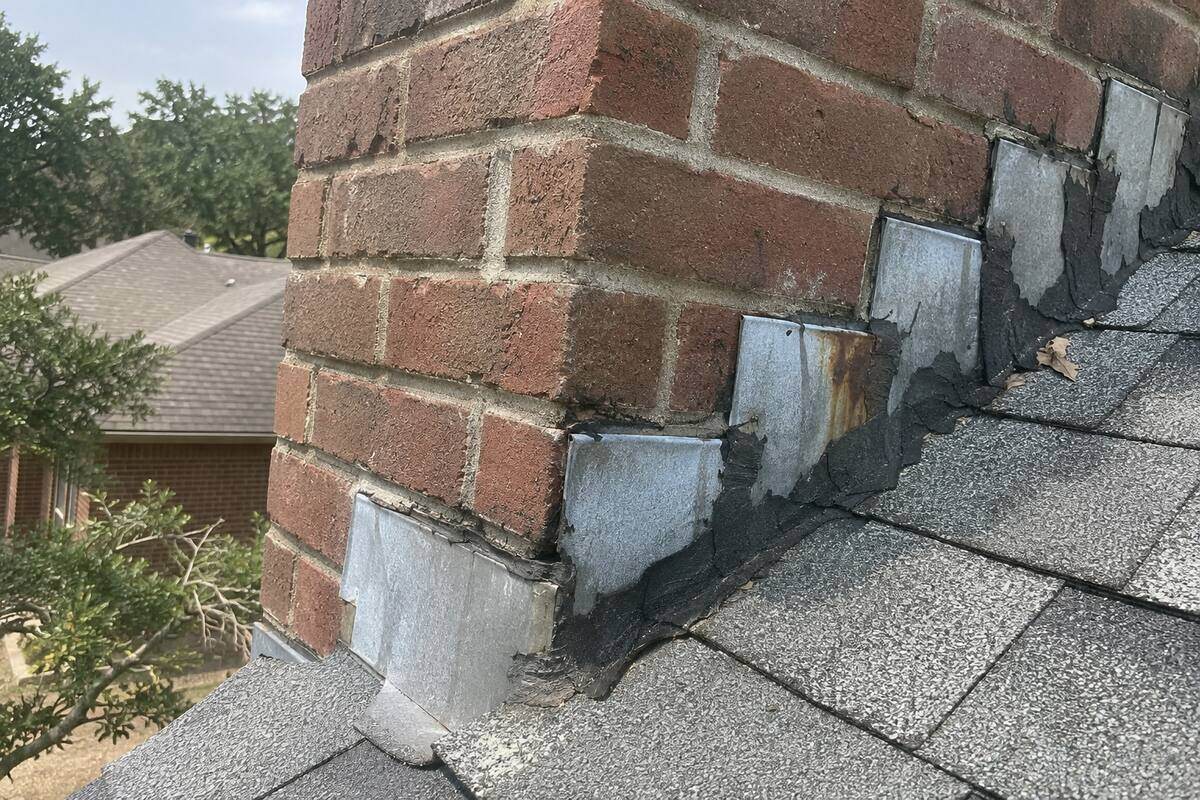
Chimney and wall flashing is different. If the original detailing was wrong — face-nailed step flashing, counter-flashing surface-mounted and caulked instead of let into a reglet, no cricket behind a wide chimney — then repairing it means redoing it, and a contractor offering to seal it for a fraction of the price is offering a different product with a much shorter life. On a roof that is close to replacement anyway, the sensible sequencing is often to do the flashing properly as part of the re-roof rather than twice.
Where a leak has not yet been traced to a specific penetration, start with roof leak repair — the attic tells you which joint to look at long before a walk of the shingles will.
The unit itself usually is not the problem. Modern skylights carry factory-fitted flashing kits and a sealed glazing assembly that outlasts the roof around them. What fails is the interface: a curb built without proper step and head flashing, a unit reinstalled on a re-roof using sealant instead of the flashing kit, or a curb whose apron has corroded. A skylight that has leaked repeatedly usually has an installation history rather than a product fault.
Almost always, if they are anywhere near the age of the roof coming off. The flashing has to be disturbed to re-roof around them regardless, the labor is already on site, and a twenty-year-old skylight left in a new roof is the component that will bring someone back onto that roof first. Getting it priced as a line item in the replacement scope is much cheaper than doing it separately later.
They are rubber, they sit in full sun on the upper slope, and Sugar Land gives them intense UV for most of the year. The collar hardens, cracks radially around the pipe, and then feeds water onto the decking every time it rains. Ten to fifteen years is a normal life here, which is comfortably shorter than the roof they are fitted to. Boots with a lead or metal collar last considerably longer and are worth specifying on a re-roof.
Sealant on flashing is a temporary measure at best and a concealment at worst. In Fort Bend County humidity it cracks, then traps moisture underneath where it cannot dry, and the decking rots out of sight while the roof looks maintained. Where an assessment finds roofing cement smeared along a chimney or a wall line, that is usually a sign the flashing was never detailed correctly to begin with.
Get connected with an independent Sugar Land roofing contractor who will look at the detail rather than reach for the sealant tube.
Call (281) 374-4829 Request an Estimate Sugar Land