Home › Services › Shingle Roofing
Composition asphalt shingle is what almost every house in Sugar Land is wearing, and it is what almost every re-roof here goes back to. What is worth understanding is why the same product that lasts twenty-five years in a mild climate is a twenty-year proposition on the Gulf Coast.
Sugar Land takes intense direct sun for most of the year. Ultraviolet exposure drives the volatile oils out of the asphalt mat, which is what makes an old shingle brittle rather than pliable.
A dark roof surface in a Fort Bend County August is far hotter than the air. Every day it expands and contracts, and every night it does it again. That cycle works fasteners loose and opens seal strips.
An under-ventilated attic cooks the shingle from underneath as well as above. This is the single most controllable variable in how long a roof lasts, and the one most often skipped on a budget re-roof.
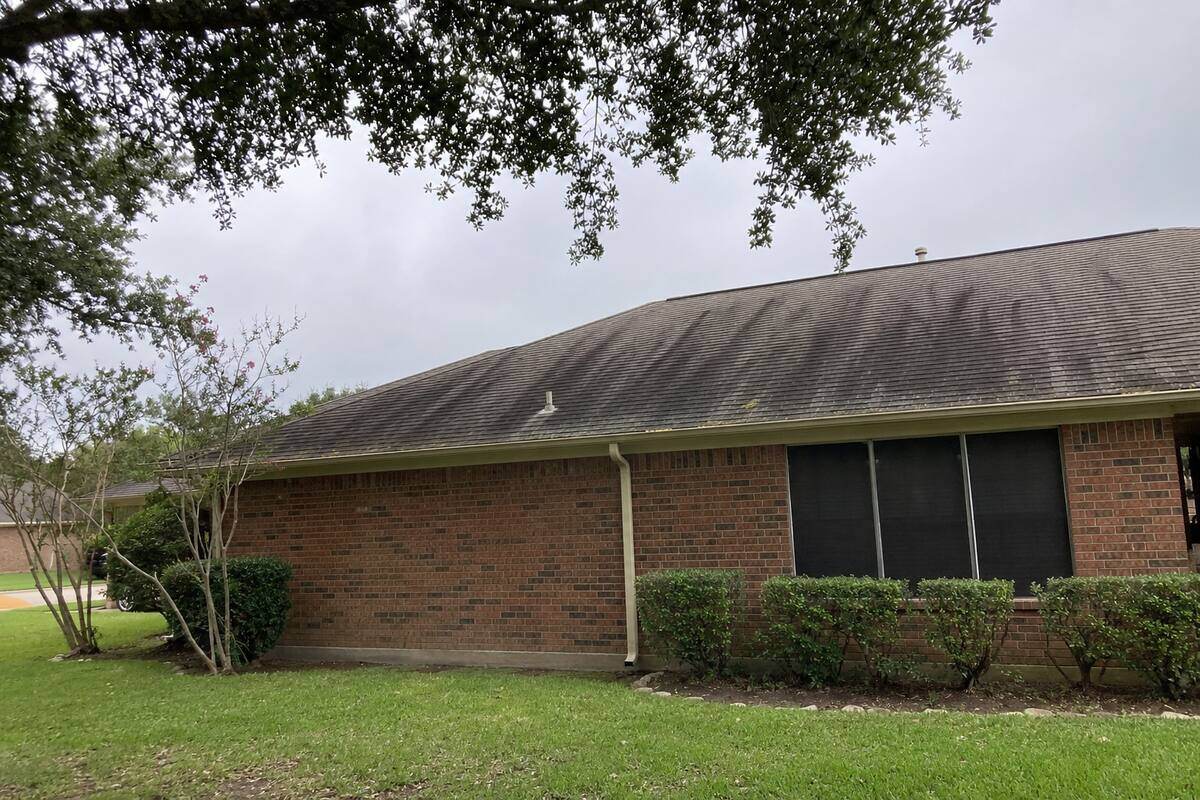
Gloeocapsa magma thrives in Gulf Coast humidity and produces the black streaking that runs down north- and shade-facing slopes across the whole city.
Frontal systems and squall lines break seal strips along rakes and ridges. A tab that has lifted once will not re-seal itself.
The end state of all of the above. Granules are the shingle's sunscreen; once they are in the gutter the mat is exposed and the remaining life is short.
The dark vertical streaking on so many Sugar Land roofs is a cyanobacteria colony feeding on the limestone filler in the shingle. It grows where the roof stays damp longest — shaded slopes, under overhanging live oaks, below sections where water sheets off in a consistent path — which is why it runs in stripes rather than covering the roof evenly.
It is a cosmetic problem far more than a structural one, and it is worth saying so because pressure washing a composition roof to remove it does real damage: it strips granules and takes years off the shingle. Where a roof is being cleaned at all it should be a low-pressure treatment. On a re-roof, algae-resistant shingle lines with copper granules are the durable answer, and the surcharge is modest against the cost of the roof.
Three estimates for the same Sugar Land re-roof will usually agree closely on shingles and differ meaningfully on ventilation, and the homeowner comparing them has no easy way to see it. Asphalt shingle needs balanced airflow — intake low at the soffit, exhaust high at the ridge — to move heat and moisture out of the attic. Exhaust without intake does not work; it just pulls conditioned air out of the house.
In Sugar Land this matters twice over, because the attic is not an empty space. The air handler is up there in nearly every house, running most of the year, and an attic that runs hot works the system harder as well as the roof. If a re-roof estimate does not mention ventilation at all, that is a question worth asking before signing anything. Roof replacement covers what else belongs in a written scope.
Two cases. On flat and low-slope sections — patio covers, additions, the flat runs on 1970s Sugar Creek and Venetian Estates houses — shingle cannot be used at all below the minimum pitch, and a membrane system is required instead; see flat and low-slope roofing. And where a homeowner intends to stay in the house for twenty-plus years, metal roofing is a genuinely different calculation rather than an upsell.
The national life expectancy for asphalt shingle is around 20 years, and Gulf Coast conditions do not extend it. There is no rigorous Gulf-Coast-specific study to point at, so the honest position is: plan around 20 years, expect the low end of any manufacturer range rather than the headline number on the wrapper, and treat granule loss in the gutters as the signal that matters more than the year on the invoice.
Less than it sounds. Those are limited manufacturer warranty terms on the shingle as a product, prorated over time and conditional on installation to specification with the manufacturer's full system. They are not a prediction of service life in Climate Zone 2A on a poorly ventilated attic. The two numbers that actually move a Sugar Land roof's lifespan are attic ventilation and how much direct sun the slope takes.
In this humidity, usually yes, and mostly for resale rather than performance. Algae-resistant lines use copper granules that inhibit the growth causing the black streaking, typically with a 10-year limited algae warranty. The streaking is cosmetic, but a streaked roof reads as a neglected roof to a buyer, and the price difference on a re-roof is small relative to the total.
Almost every Sugar Land re-roof lands on architectural (dimensional) shingle now, and three-tab is largely a repair-matching product. Architectural is heavier, carries a higher wind rating, hides deck irregularities better and looks closer to what the neighborhood already has. Where an HOA has architectural guidelines — and in First Colony's fifty-plus neighborhoods it usually does — the approved list is generally architectural anyway.
Get connected with an independent Sugar Land roofing contractor and ask what the ventilation plan is.
Call (281) 374-4829 Request an Estimate Sugar Land