Home › Services › Gutters & Drainage
A 2,500 square foot roof sheds a great deal of water in a Gulf Coast downpour. Where that water lands is the difference between a drainage detail and a slab problem — because in Fort Bend County the ground around your house changes size depending on how wet it is.
Every square foot of roof drains to an edge. A roof with no gutter delivers all of it in a line along the drip edge, straight down onto the ground within a foot or two of the wall.
The Beaumont Formation underlies the area and is highly expansive: it swells as it takes on water and shrinks as it dries. The region alternates between very wet spells and multi-year droughts, so it does both, repeatedly.
Moisture change is greatest in the outer 8 to 10 feet around a slab. That is the band that moves. Under the middle of the house, moisture content stays comparatively stable.
A slab that rises and falls uniformly is fine. A slab whose edge moves while its center does not is the one that produces cracked brick courses, doors that stop latching and diagonal cracks off door frames.
None of the links in that chain are controversial, and only the first one is a roofing decision. That is what makes gutters a genuinely high-value item on a Sugar Land house rather than a cosmetic trim upgrade. Where the movement has already happened and the slab itself needs attention, that is the other end of this.
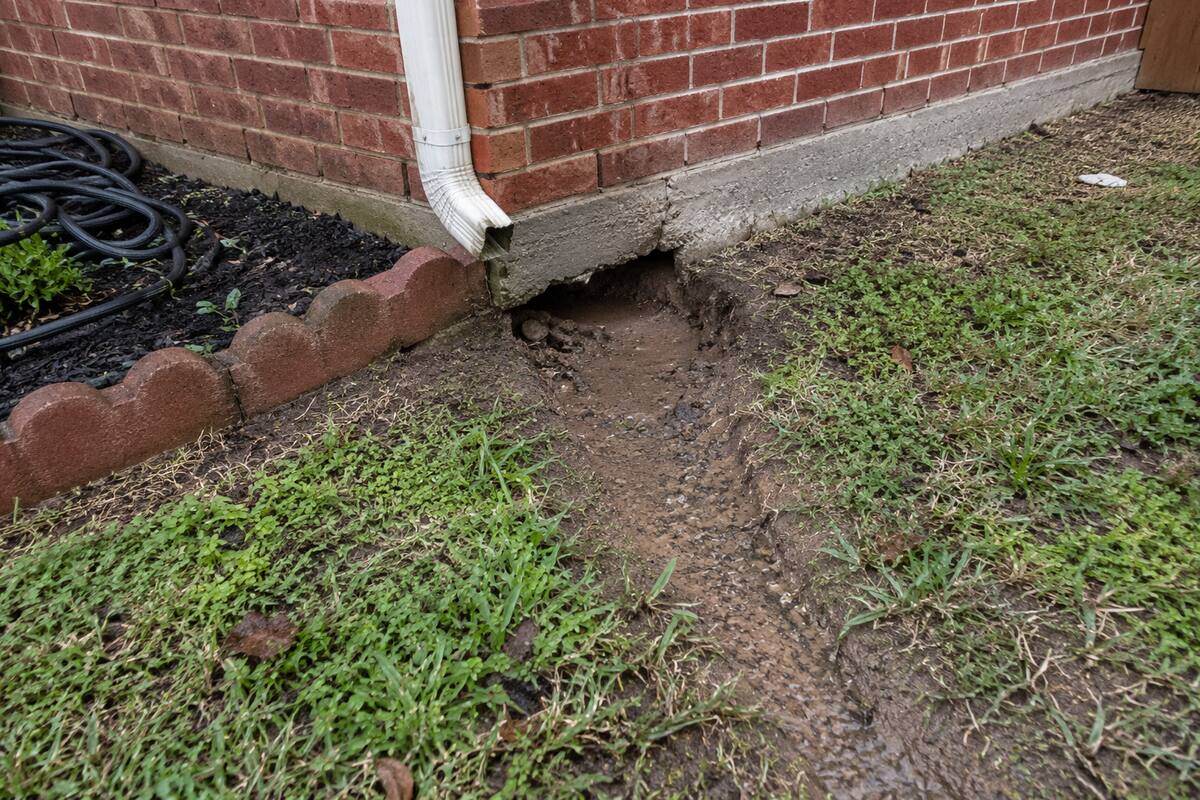
The commonest deficiency is not missing gutter, it is too few outlets for the roof area feeding them. A long run with a single downspout overflows at the corners in any real Gulf Coast rain, which puts the water exactly where the gutter existed to prevent.
Extensions, buried lines to pop-up emitters, or a graded swale. Not a splash block at the wall.
Beds built up against the brick, mulch piled to the weep holes and settled soil at the slab edge all defeat good gutters. The ground should fall away from the house, not toward it.
A valley on a complex 1990s roofline concentrates several slopes into one path. Wherever a valley discharges, that gutter section is doing several times the work of the rest.
Sugar Land's mature tree canopy is one of the best things about the city and the worst thing about its gutters. A blocked gutter is functionally no gutter, and it also holds water against the fascia.
Gutters hang on the fascia. Rotted fascia is both a gutter problem and an animal entry point — a gap at a soffit or roof return is how squirrels get into a Sugar Land attic in the first place.
Worth separating two things that get confused locally. Nine Levee Improvement Districts cover most of Sugar Land, and FBC LID No. 2 alone protects more than 9,000 First Colony homes across 5,300 acres with eleven miles of levees, eight miles of ditches and three pump stations, FEMA-accredited. That is why a great many Sugar Land houses sit near the Brazos and are nonetheless outside the mapped high-risk flood zone — fewer than 1% of Sugar Land homes flooded during Harvey, when the river crested at a record 55.19 feet.
Gutters have nothing to do with any of that. Regional flood protection is a district-scale system; roof drainage is a slab-perimeter moisture problem measured in feet. A house can be perfectly safe from the Brazos and still be moving because its downspouts discharge at the wall. They are separate problems with separate answers, and conflating them is a reliable sign that whoever is talking does not work here.
More here than in most places, and for a reason that has nothing to do with the roof. Fort Bend County sits on highly expansive Beaumont Formation clay. That clay swells when wet and shrinks when dry, and the part of it that moves most is the outer 8 to 10 feet around the slab — exactly where roof water lands if nothing carries it away. A house with no gutters is running a wet-dry cycle on its own foundation edge every time it rains.
Past the active zone, which means getting water beyond that outer 8 to 10 feet of slab perimeter rather than a token two feet. Extensions, buried drain lines to a pop-up emitter, or a discharge into a swale that runs to the street all do the job. What does not do the job is a splash block at the base of the wall, which is the most common arrangement in the city and the least effective.
Under mature live oaks and crepe myrtles, some form of guard usually pays for itself in avoided cleanings — but no guard makes a gutter self-maintaining, and the fine leaf litter live oaks drop gets through most of them. Treat a guard as a way to stretch the interval between cleanings rather than eliminate them, and be skeptical of any product sold on the promise that you will never look at the gutter again.
The mechanism is well established in the Texas engineering and inspection literature: expansive clay changes volume with moisture content, differential moisture around a slab perimeter produces differential movement, and differential movement is what cracks slabs and separates brick. Roof water is simply the largest single source of concentrated moisture a house controls. It is not the only factor — drought cycles, trees and plumbing leaks all contribute — but it is the cheapest one to fix.
Get connected with an independent Sugar Land roofing contractor and get the discharge moved past the slab.
Call (281) 374-4829 Request an Estimate Sugar Land