Home › Services › Flat & Low-Slope Roofing
Most Sugar Land houses that have a flat roof have only a piece of one: a patio cover, a porch, an addition, or the run built into a 1970s design between two pitched sections. It is a different system from the rest of the roof, it fails on a different schedule, and it is where a house leaks first.
Sugar Creek was built from 1972 and Venetian Estates goes back to the late 1950s. Both carry a good deal of period architecture where a flat or near-flat section is part of the original design rather than an addition — and on a house that age, that section has been redone more than once.
Across every neighborhood and every era. Almost always low slope, almost always the newest and worst-detailed roof on the property, and usually tied into the main roof at a wall — which is a flashing joint, not a roofing joint.
A sunroom, a converted garage or a bumped-out primary suite frequently ends up with a shallower pitch than the original house because of ceiling height inside. That is a low-slope roof whether it was designed as one or not.
On complex 1980s and 1990s rooflines a short flat or shallow section sometimes connects two pitched planes. Easy to miss from the ground; a chronic problem once it fails.
This page is about houses. A multi-tenant building, a retail center or a warehouse is a different roof, a different system and a different buyer — that is commercial roofing.
The most common residential answer here. Rolled sheets in overlapping courses, seams heat-welded or adhered, with a granulated cap surface. Well suited to a patio cover or an addition, and repairable in place.
A sheet system adhered or mechanically fixed, with welded seams. More usually a commercial answer, but used residentially on larger low-slope areas.
The older layered felt-and-asphalt system found on original 1970s work in Sugar Creek. Durable, heavy, and generally replaced rather than extended when it finally goes.
Whichever system is used, the part that decides how long it lasts is not the field of the roof. It is the perimeter and the terminations: how the membrane turns up at a parapet or a wall, how it is counter-flashed under the siding or brick above it, how it terminates at a scupper or a drain, and whether the fall is genuinely enough for water to leave. A low-slope roof that ponds after every rain is telling you about its slope, not its material.
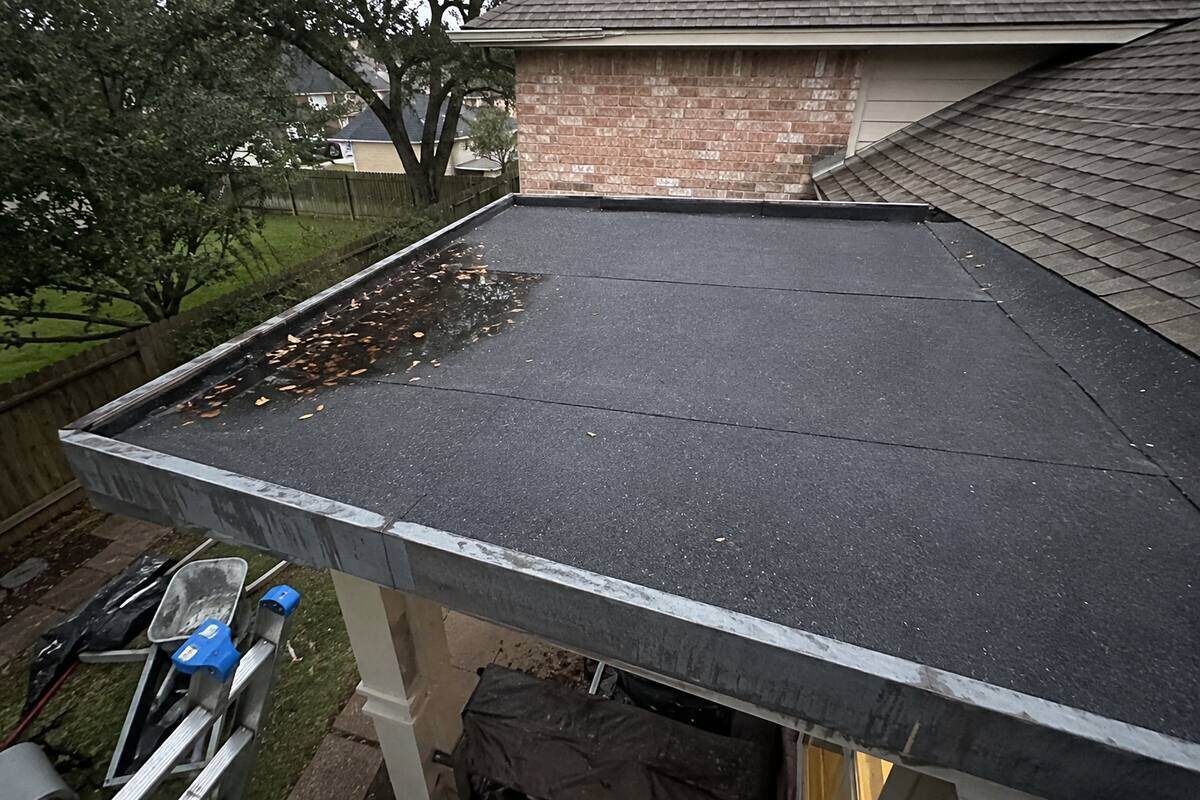
The definition of ponding. It means the fall is inadequate or a drain is blocked, and it is the condition that shortens every low-slope system.
Visible edges where the courses meet, especially where they run across the direction of flow.
Trapped moisture or vapor under the membrane, expanding in Gulf Coast heat. A blister that has split is an open roof.
Where the low-slope section meets the house wall. Sealant used instead of proper counter-flashing is the most common shortcut on a patio cover, and it has a service life measured in a few seasons.
Live oak litter is everywhere in Sugar Land and it collects where water is slowest. Debris holds moisture against the membrane and blocks the drainage path.
A low-slope section that discharges straight onto the slab is a foundation issue in Fort Bend clay, not just a roofing one — see gutters and drainage.
Nothing is truly flat — every low-slope roof is built with a fall so water leaves it. In practice the dividing line is the minimum pitch at which asphalt shingle may be used under the adopted code. Below that, shingle is not permitted regardless of how it looks, and the section needs a membrane or rolled system instead. On most Sugar Land houses the flat run is a patio cover, a porch roof, an addition, or a section between two gables.
Because water sits on it. On a steep slope water is gone in seconds and a small defect never gets tested. On a low-slope section, a ponding area holds water against the seam for hours after the rain stops, and a seam that would never fail on a pitched roof fails there. Ponding also collects debris, which holds moisture longer still.
No, and it is a common request. Below the code minimum pitch, shingles rely on gravity that is not there and water works back under the courses by capillary action and wind. A shingled low-slope run will leak, usually within a season or two of the first serious storm.
Shorter than the pitched roof next to it, generally. Modified bitumen and single-ply systems on a residential patio or addition typically run in the 12- to 20-year range depending on the system, the detailing at the perimeter and how well water actually leaves it. Because the flat section usually goes before the main roof, it is common for a Sugar Land house to have the two replaced on separate cycles.
Get connected with an independent Sugar Land roofing contractor who works on residential low-slope systems, not just shingle.
Call (281) 374-4829 Request an Estimate Sugar Land