Home › Services › Roof Replacement
A composition roof on the Gulf Coast has a working life of about twenty years. Sugar Land built 57.4% of its housing between 1980 and 1999, which means a very large share of the city is at, near or past that number right now — independent of whether a storm ever came through.
"Replacement" is a sequence, not a single act, and the price differences between contractors usually live in steps two and four rather than in the shingle everyone talks about.
Every layer comes off down to the decking. This is the step an overlay skips, and skipping it is why an overlay is cheaper.
With the roof bare, soft, delaminated or rotted sheets are visible and get replaced. Priced per sheet, and quoted per sheet before the day if the estimate is honest.
Underlayment, plus ice-and-water or peel-and-stick membrane in the valleys and around penetrations. On a Gulf Coast roof this layer does a great deal of the actual work.
New pipe boots, step and counter flashing at walls and chimneys, drip edge. Re-using old flashing to save a few hundred dollars is the most common corner cut in this market.
Intake at the soffit and exhaust at the ridge. A Sugar Land attic running an air handler through eight months of cooling season is unforgiving of a roof that cannot breathe.
Field, hip and ridge. Then a magnet pass across the driveway and beds — ask whether that is in the scope, because it is not always.
The Houston-market average for a full residential roof replacement is $9,752, with a typical range of $6,712 to $13,123. Sugar Land sits in the upper half of that range more often than not, for reasons that have nothing to do with contractors charging city-specific prices:
First Colony, Riverstone, Telfair and Avalon houses run well above the metro average square footage, and roofing is priced by the square.
Multiple gables, dormers, valleys and turret features on 1990s and 2000s Sugar Land production housing all add cut waste, flashing and labor per square.
Steeper is slower and needs staging. A 4:12 ranch in Covington Woods and a 10:12 two-story in Telfair are not the same job at the same price.
Unknown until tear-off. This is the single most common reason a final invoice differs from an estimate, which is why the per-sheet number belongs in the written scope.
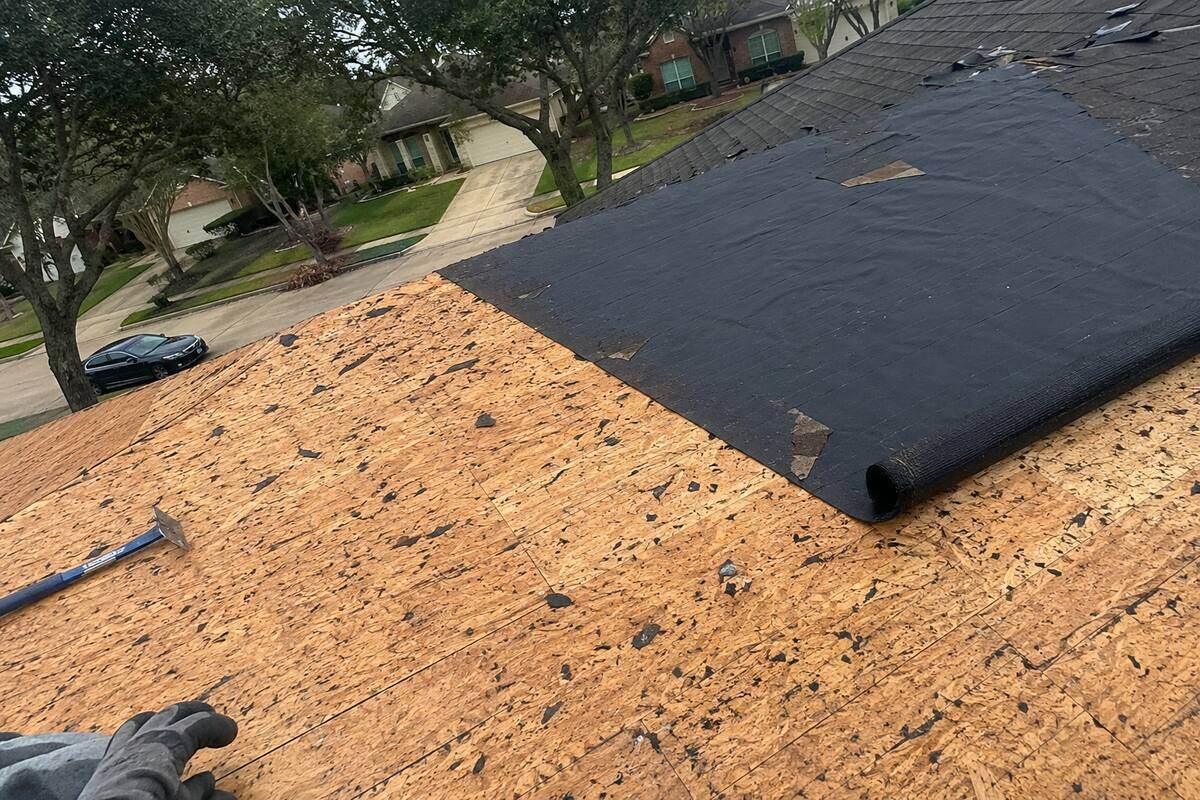
An overlay — a second layer of shingles laid over the existing roof — is legal in Texas under the adopted International Residential Code up to two total layers, and it is genuinely cheaper on the day. It is also the reason a lot of Sugar Land houses reach their next replacement with a bigger bill than they needed.
The case against it is structural rather than aesthetic. An overlay leaves the original decking unseen, so anything already rotting under a long-standing vent-boot leak stays there. It roughly doubles the weight the roof carries. It runs hotter, because the trapped layer beneath holds heat, and heat is what drives shingles to lose granules. And it makes the next tear-off a two-layer job. Sugar Land's 2024 code adoption is the governing standard here, and the City's Building Standards office is the place to confirm what a specific address needs; roofing permit requirements are set locally, not by the state.
Most Sugar Land re-roofs land on architectural composition shingle, which is the regional default for good reasons — see shingle roofing for how it behaves in Gulf humidity. Where a homeowner is planning to stay twenty-plus years, standing seam metal changes the arithmetic: roughly $23,100 against $9,700 for asphalt in this market, against a service life that can be two to three times as long. A house with flat runs over a patio or an addition needs a second system entirely — flat and low-slope roofing covers that.
One thing worth settling before the estimate: whether the roof is actually due. A roof that is fifteen years old and in decent condition is a different conversation from one that is twenty-two and shedding granules into the gutters. Roof age and condition assessment is the page for that question, and it is worth reading before spending five figures.
Most single-family re-roofs here are a one- to two-day job once material is on site: tear-off in the morning, decking inspection and repair, dry-in, then shingles. Larger First Colony and Riverstone houses with complex rooflines and steeper pitches run longer. Rain moves the schedule; a roof cannot be dried in and left open overnight.
Yes, and it is usually the wrong economy. An overlay puts a second layer over the first, which hides the decking rather than inspecting it, adds weight, runs hotter, and shortens the life of the new shingles. It also means the next replacement is a two-layer tear-off at a higher price. The International Residential Code caps a roof at two layers, so a house that has already been overlaid has no option but a full tear-off.
No. On most Sugar Land houses the decking is sound and only isolated sheets are soft, usually around a chimney, a valley or a vent boot that has been leaking quietly. Ask for the per-sheet decking replacement price in writing before work starts, because it is the line item most likely to move on the day of tear-off.
There are two, and they are different things. The manufacturer warrants the shingle itself, with longer terms available where the installer holds that manufacturer's certification and the full system is used. The contractor separately warrants workmanship, and that term varies widely. Get both in writing, and check the workmanship term against how long the contractor has actually been at a Fort Bend County address.
Get connected with an independent Sugar Land roofing contractor for a written scope and estimate.
Call (281) 374-4829 Request an Estimate Sugar Land